
The Intelligence of Connection
How connection organizes life and what changes when we begin to participate in it consciously.

Part 3 in a series on Living Systems, Connection and Conscious Participation.
THE DRIVE:
Love and grief, two boundless forces, were driving us 400 miles through the desert.
It was an unseasonably warm early spring. The Palo Verde trees were already in bloom, their branches heavy with bright yellow flowers. So beautiful to see this living splash of color in a painted blur as we drove past.
But I knew what it meant.
These blooms were arriving early, pushed forward by prolonged heat. A subtle shift in timing. A signal, if you knew how to read it. Easy to miss, if you don’t.
We left before sunrise to beat the city traffic, heading back out to Arizona. It was a reflective drive. Shaped both by where we were going and from where we came.
Love and grief, moving in parallel.
There were two purposes for the trip. That evening, I had organized a private gathering for a friend grieving loss. The next day, we would meet with a couple I was preparing to marry; to help them shape the beginning of their life together.
As the desert landscape sped by, both lived in me at once; like two currents moving through the same channel. My thoughts moved just as quickly. In the foreground, the immediacy of what lay ahead; the logistics, the people, the weight of what each moment might hold.
But underneath that, in the background, something else was taking shape.
A quiet recognition of pattern.
Of how systems hold.
Of how they strain.
Of how they signal when something is no longer in balance.
Before we can meaningfully change how we act, we have to change how we understand. Behaviors emerge from beliefs.
Beliefs emerge from how we perceive the world.
And those ways of seeing are shaped long before we consciously choose them.
REFELCTIONS:
In Nested, the shift was perceptual: human systems are not separate from life, but contained within it.
In Our Problems Are Not Our Problem, that lens sharpened: What we treat as isolated issues are often symptoms of deeper misalignment - signals arising from the systems they are embedded within.
Taken together, this leads to a more fundamental set of questions:
If we are nested within living systems and, our problems reflect misalignment with them,
Then how do those systems actually work?
What is the nature of connection that organizes them?
And how do we participate coherently in it?
FASCIA:
There is a real world example of the living fabric of connection — especially poignant to look at because it has recently undergone a paradigm shift of its own.
For a long time, fascia was considered little more than biological packing material; inert tissue that held muscles and organs in place.
That view is quietly collapsing.
I didn’t first encounter it through that lens though. For me, it came through a detour.
My wife, a western-trained nurse, and I had found ourselves searching for answers where conventional medicine had left us wanting. That search led us into meditation and breath-work practice, and eventually into a Reiki training — a system that speaks in the language of energy, flow, and subtle sensing.
I was intrigued. But also skeptical.
Through an unconventional path, I’ve learned to be my own critic. If something is real, I need to find the bridge, the model that anchors metaphor to structure.
So I extended that framework and followed it through. Beginning wirh what I remembered from a college course on Eastern Science and Medicine; Meridians and Qi; acupuncture and pressure points - leading me ultimately to the enveloping world of fascia.
And what I found there was unexpected.
Fascia is now understood as a continuous, body-wide network; sensing, transmitting force, adapting to stress, and communicating information. It responds to movement, hydration, trauma, and emotion.
It is not passive structure.
It is connective intelligence.
…It takes a while for that concept to sink in.
Right under our noses (even of our noses?) a living example of how systems organize coherence, not through isolated parts or centralized control, but through relationship, responsiveness, and continuous feedback.
Fascia connects everything without erasing difference, forming a distributed sensing web rather than a centralized command.
Muscles remain muscles. Organs remain organs. And yet nothing operates in isolation. Tension in one area is transmitted across the whole. Ease, too, has a way of spreading.
This is sometimes described as tensegrity — where stability emerges not from rigidity, but from balanced relationships under tension, or the relationship of tension and compression in process.
When the system is healthy, fascia remains elastic and adaptive.
When overwhelmed by injury, chronic stress, or trauma, it densifies.
Movement becomes restricted. Sensation dulls.
Adaptability decreases.
The system doesn’t stop functioning.
It loses access to range.
CROSS SCALE PATTERNS:
We see this in people.
We see this as well in other systems under pressure, in environments pushed beyond their capacity to regenerate.
The patterns are not identical. But they rhyme.
Across scales, fragmentation looks the same:
A loss of responsiveness.
One of the clearest distinctions this reveals is the difference between control and regulation.
The body does not manage fascia through command, it exists in relationship and in process. A living network that communicates signals bi-directionally or perhaps more aptly put, in the round.
Regulation emerges through continuous feedback:
Pressure.
Sensation.
Movement.
Breath.
The system listens.
It adjusts.
It learns.
Many of our human systems are built on the opposite assumption; that stability comes from prediction and control.
But living systems don’t remain viable by controlling change.
They remain viable by staying in relationship with it.
BREATHWORK:
In breathwork, something subtle becomes clear.
Breath sits at the edge of conscious and autonomic control. You can spend your whole life without giving breath a second thought, it’s automatic.
But with intention, we begin to participate consciously.
Not by forcing change, but by working with what is already in motion.
The more fully you engage the breath — deep, rhythmic cycles of inhale and complete exhale — the more the system begins to shift.
Energy builds. Sensation expands. Boundaries soften.
And then…something releases.
FRIDAY NIGHT EVENT:
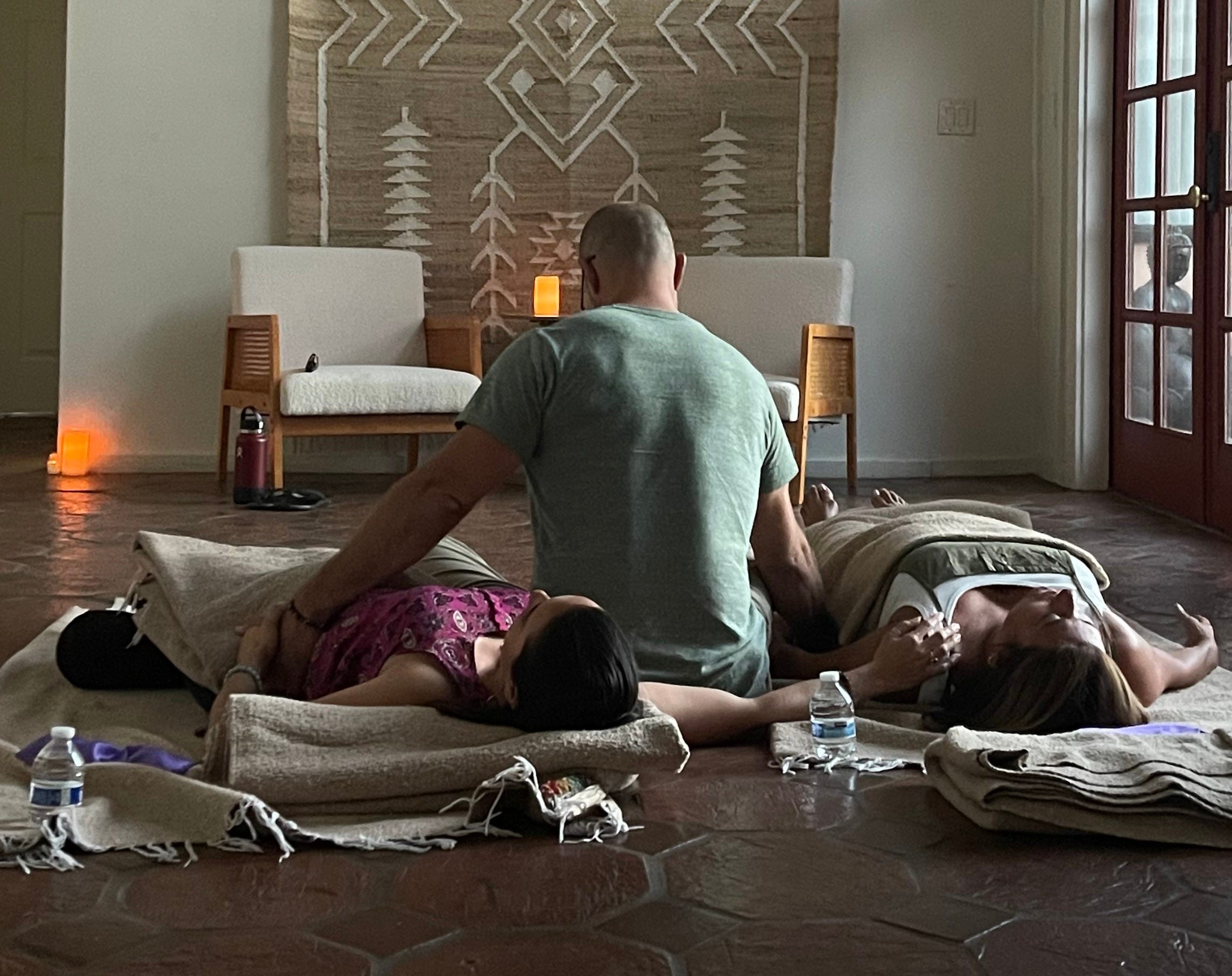
There were five of us in the room: My wife, our friend, and myself; along with Jen and Destinee, our breath-work and sound facilitators.
The room was quiet. Late afternoon light filtered in, soft and low. The rest of the building was empty. Everything about the space felt calm, comforting, held.
We were working with a holotropic breathing pattern: a continuous cycle of deep, two-part inhales followed by full, complete exhales.
At first, it seems simple.
What begins as breath becomes something more:
Effort shaping sensation.
Sensation guiding response.
Response reinforcing pattern.
When you commit to the breath, something shifts.
It’s as if larger gears begin to turn. Energy flow shifts. Circulation changes. Sensation intensifies.
At a certain point, it can feel like your entire body is vibrating, not metaphorically, but physically, as if something long held in place is beginning to move.
And then it happened…
A scream pierced the room. Primal. Visceral. Emotion in its rawest form.
Not rupture. Not distress in the way I might have once understood it.
It was a signal: Release.
A system under pressure, expressing what had been held beyond its capacity to contain.
What was moving in that moment was not just emotional.
It was physiological.
Breath, applied with intention, was shifting the autonomic nervous system — altering rhythm, unlocking stored tension, restoring pathways of response that had gone quiet.
Not by force.
Not by control.
But by creating the conditions for the system to respond.
Just as the desert signals through heat and bloom,
the body signals through tension, sensation, and release.
What struck me later was how familiar this pattern felt.
DIFFERENT CONTEXTS - FAMILIAR PATTERNS:
Some time ago, I had brought a close friend in California out to Joshua Tree under very different circumstances. He had hit a breaking point; overwhelmed, unreachable and gone for a few days. His wife and family was more than a little worried.
He wasn’t someone inclined toward traditional therapy. So instead, I brought him into a different kind of space.
We worked with breath.
With sound. With stillness.
And with movement.
Not to solve anything in that moment, but to help his system regulate. To give him access to something he could feel, not just think about.
It was about restoring connection…And hopefully revealing access to tools he could tap into and cultivate whenever helpful.
Just a few months later, I found myself returning to those same practices in a completely different context.
Sitting with a couple I would later marry.
Not in crisis, but in preparation.
Working with breath and presence to help them ground into themselves, into each other. Not to fix something broken, but to build coherence proactively. To approach with conscious intention and preparation, not just the wedding day, but the union itself.
The same tools. The same principles.
One applied in collapse.
The other in creation.
Both pointing to the same thing:
Connection is not situational.
It is foundational.
“All of life is a meditation. Most of it is unintentional.” - Joseph Campbell
INTENTION:
This is where intention becomes essential.
Small shifts in attention and intention accumulate; shaping patterns over time.
This is how living systems evolve: Through continuous interaction.
Feedback, response, adjustment.
Connection is not just something we experience.
It is something that organizes — an intelligence expressed through relationship, feedback, and responsiveness.
Over time, what we repeatedly participate in begins to take form.
In the body, intention turns breath into a tool for regulation.
In relationships, it shapes the quality of presence we bring to one another - Or to the relationships we hold with the world around us.
What we attend to grows.
What we avoid persists.
What we reinforce becomes structure.
The same is true at larger scales.
LARGER SCALES AND FEEDBACK LOOPS:
Communities are shaped by the quality of attention within them.
Systems are shaped by the patterns we normalize.
Institutions reflect the accumulation of repeated choices.
Over time, these patterns stabilize.
They begin to feel fixed.
Inevitable.
But they are not static.
They are the result of ongoing participation — shaped by feedback, reinforced through repetition, carried forward through time.
What combining breath and intention teaches us intimately and within our own bodies, is that we do, in fact, have the ability to influence systems thought beyond our control. What is important is to extrapolate this forward.
Embodiment is where this becomes undeniable.
The body is not separate from the systems that sustain it.
Breath mirrors atmospheric exchange - Is, in fact, a part of it. Circulation echoes watershed flows.
Connective tissue and our neural network reflects the relational logic found in forests and mycelial networks.
Through the body, the living Earth is not an abstraction.
It is experienced directly.
Also through the body, paradigms are revealed. Our views of health, the body, the brain, the mind reflect the deeper worldviews from which they’ve grown. The body as a collection of parts, the separation of the mind and the body, the brain as a machine or computer - these are all reflections of historical worldviews that are beginning to change across the board.
Trauma is not only psychological. It is patterned into tissue.
Beliefs are not only intellectual. They are lived.
Even separation becomes something we feel.
Stepping back into the arc, a broader pattern comes into view.
Life is enfolded with nested, interdependent systems:
The Earth makes embodiment possible.
The body shapes perception.
Perception forms paradigms.
Paradigms shape human systems.
Human systems act back upon the Earth.
When these layers remain aligned, systems generate resilience, adaptability, and regeneration.
When they fragment, we see the opposite:
Rigidity instead of flexibility.
Control instead of responsiveness.
Disconnection instead of relationship.
Integration, then, is not primarily ideological.
It is also physiological.
And increasingly, it becomes a question of design.
DESIGNING WITH INTENTION:
Life has always known how to organize itself.
Through relationship.
Through feedback.
Through connection.
The question is not whether that intelligence exists, but whether we are willing to recognize it, to align with it, and to begin shaping our systems in ways that participate in it rather than override it.
What would it look like to make it intentional?
And what would it mean to design our lives, and the systems we build as a conscious participation in the intelligence of connection?
Because if connection is not just something we feel, but something that organizes life itself, then the way we design, build, and relate is no longer neutral.
It shapes the conditions we live within…
…And the patterns that shape us in return.
In the next essay, I’ll explore what this means when we begin to design, intentionally, within living systems.
A heartfelt thank you for taking the time to read my work. This is part of an ongoing series exploring how we understand and participate as living systems in the living systems of our living world.
Read Part 1: Nested
Read Part 2: Our Problems are Not Our Problem