
Our Problems Aren't Our Problem
How we unconsciously model the patterns that perpetuate them

Standing there, looking out into the faces of hundreds of people, some of whom I knew like family and others I had never met; all looking back at me, I could feel the full weight of every single heart.
Each one open, exposed, wounded, bleeding, beating and vulnerable. Each one searching for some kind of meaning in the face of the unfathomable.
As this hall of people looked to the front of the room and saw me holding space preparing to speak, I looked out at each soul and saw the collected composite of my friend’s life interwoven throughout all the wet eyes, reflecting the connected memories held by everyone. Reflecting a shockwave of pain carried by all.
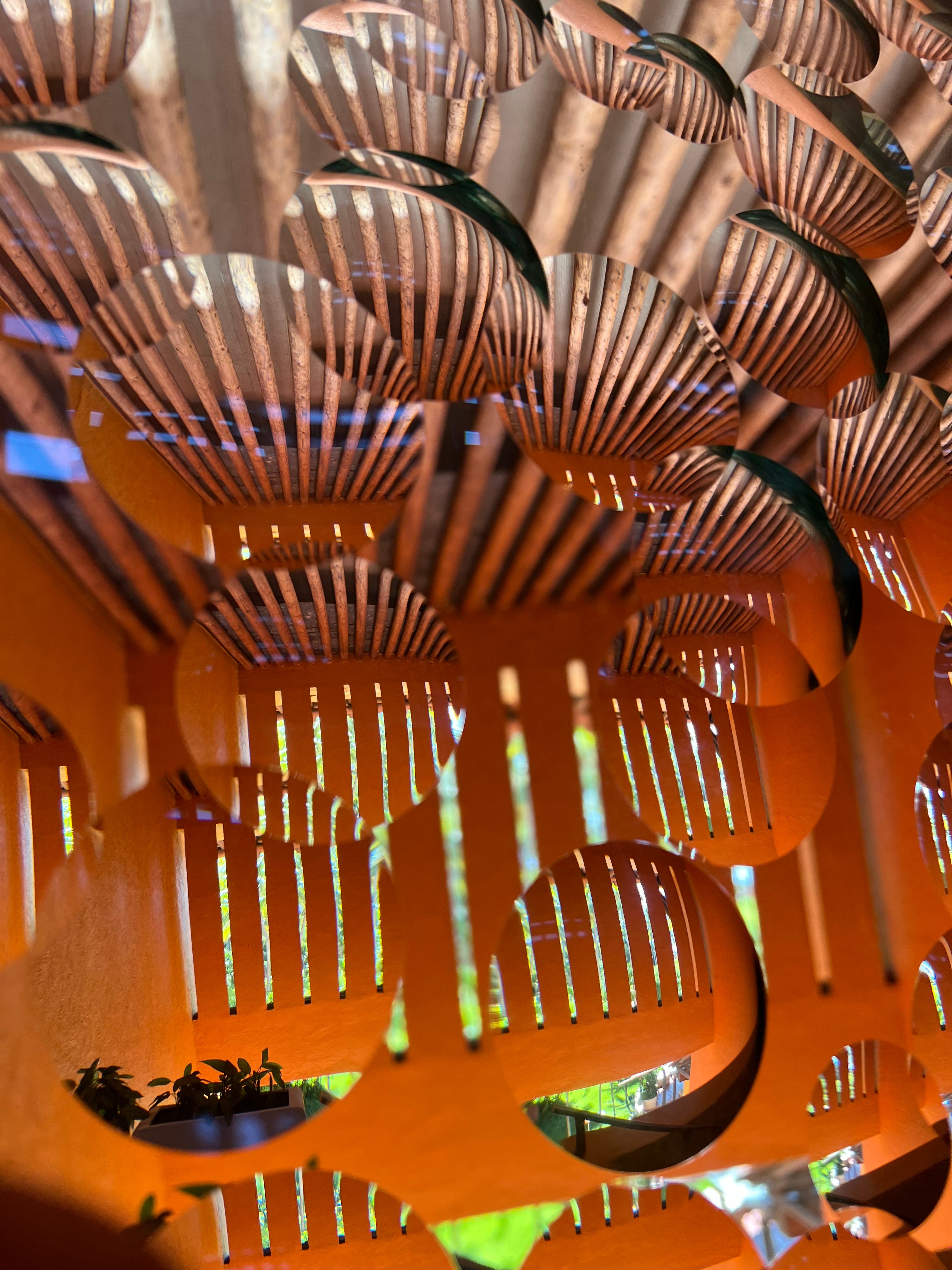
I was to speak of my friend’s life - to my friend’s life. The complex network of relationships he held, embodied and collected. All these other ends of his outward experiences, tied like threads through all those in the room before me. One end now loose; blowing freely, unanchored, untethered…trembling…eyes looking to me to gather and hold.
It’s one of the hardest…and most profound things I’ve ever had to do.
Interdependence became palpable standing in that room, holding all those intersections of connection. More than an ineffable concept, the feelings and emotions made it visceral, visible. The boundless aspects of both love and grief articulate the complex network of connections as well as show how fragile our sense of it has become.
In the last essay, I described this tension using two simple circles; one representing the natural world we live On, and the other representing the man-made world we live In.
In one image, the circles are side by side: Separate, illustrating a mindset that sees the world as here for us, to do with as we see fit. In the other, one circle is contained within the other, showing how life actually organizes: folded within, and dependent upon the self-organizing system of Nature.
But, the mindset that holds these circles apart is the overwhelmingly dominant worldview. And it’s so patterned into our story, so omnipresent, that it becomes nearly invisible. Even when we’re compassionate to the expressions of this imbalance, articulated through the emergent issues of our time.
Reinforced through statements of belief like, “Money makes the world go round” and “That’s just the way the world works”, it says simultaneously, “The world we’ve created is primary” and “Our problems and systems are too big for ordinary people to have impact”.
I’ve spent much of my life trying to understand this an underlying common denominator.
When my friend’s words reinforced this, I felt, in part, like a failure and in part like a fool.
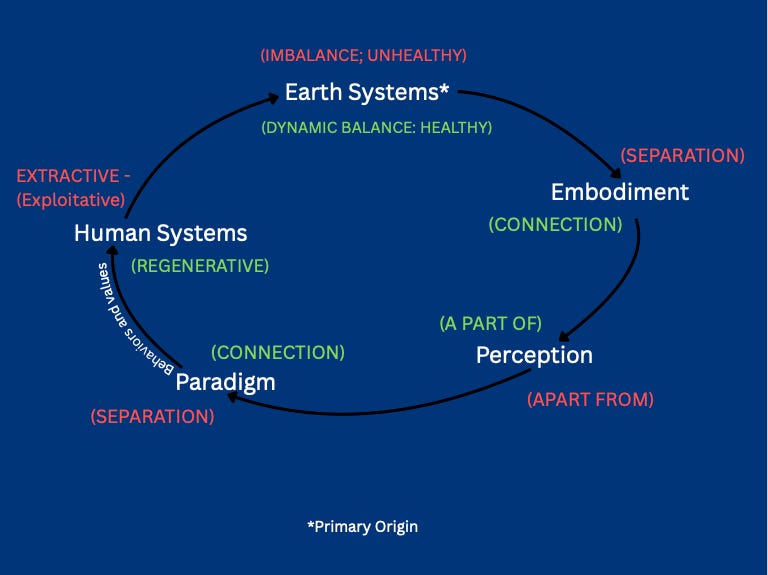
The paradigm that keeps those circles apart did not emerge by accident. It was shaped by necessity; by survival.
Underneath much of our progress and design is a mental framework of separation and control because that has been our survival story. This is the origin story for the Paradigm of Separation.
We’ve inherited it. This itself has evolved alongside our own growth and development. Bringing along with it both the advances we shine the lights on and the traumas we avoid.
We can see the full expression of this unfolding across the streets of our cities today.
It can be understood as a survival pattern that stabilized under historical conditions of threat and scarcity. We can try to understand it looking backwards, but looking ahead we need to be able to see with eyes unfettered by the same framework.
Every paradigm carries both gifts and costs. The costs of this one are no longer abstract and far from affordable.
This shows up in our own physical and emotional bodies. The mental health crisis is referred to as a global epidemic in scope. According to the WHO (World Health Organization) more than a billion people are living with mental health disorders.
No one knew my friend was struggling. He was known as one of the most successful in our group. He hid much of his troubles from his wife. She hid much of their troubles from their networks of support.
This is the thing about a worldview rooted in a Paradigm of Separation. It reduces. It isolates. It uncouples and disconnects the systems of symbiosis, dynamic balance, health, and support.
And yet, beneath this fragmentation, there remains a deeper rhythm. One that does not isolate, but integrates.
He loved music. Felt it with his whole being. Watching him dance was like watching music incarnate. Every shared memory has a soundtrack in the background.
So many songs connect me with him in the landscape of my life over the thirty years since we met. Road trips, dinner parties, concerts, camping, miles and milestones.. The hard places and high spaces of life entwine the fabric of our friendship…
A big part of the work before us is separating the story we tell ourselves and each other of “The way our world works (In)” from the story of the way the world actually works (On). Learning, once again, how to listen to the Language of Life and bring these worlds in balance.
…He was the first person I would share my latest expression of creativity with, and he was always a fan. I think he would have liked this one. It fits well here.
Language of Life:.
The deep undulating beat - Setting the tone. The depth. The frequency
Determining a spectrum of resonance, of syncopating wavelengths
Each song establishing an underlying denominator;
Creating the parameters for rainbows The arcs of dreams and the prism of colors bending
Where light meets imagination,
Through which the fluttering specks of what is, what was, and what could be
Dance and play.
On top of this beat, or perhaps from within
Nuance and contour are added - in layers of variegated quality
Sounds that take up and make up difference spaces, like
The conversations of bird calls from various vantages of the forest canopy
Mixing with the soft and subtle sounds of water or breeze.
Each a voice - with something to add .
Overlapping rhythms juxtapose, like mixing heartbeats
of a hummingbird and a Douglas Fir.
Or the slow, steady rhythm of waves crashing.
Water on water. Water on air. Water on land. Water on sand
The sliding sound of the break; push, pull, climb and recede.
The patterns left in the wake of these relationships;
Reflected in cloud and sand. Written into rings of the tree.
See how it all works together. Each part adds a voice - to the voice
Each one shapes the song; giving fullness, richness, each one belongs
Synchronicity/syncopation - The cycles of timing are different.
The snares distinct from the beats of bass. The solos slide
Each in their own way, across the rhythms.
Yet, in this cacophony that is the Music of Life
there is synchronicity - and this is Healing
in the Balance and Belonging, to this song.
Rhythms that establish a place for each distinct voice to Exist
Belong, and Contribute.
Shaping the Growth, shaping the Change
In a way that celebrates this song as One, Of many voices.
But, and this is the key point - these rhythms, these voices -
Each one syncopates.
I learned there are 73 octaves to the electromagnetic spectrum of nature.
Described as the range of Nature’s music which we ourselves are a part.
Every distinct voice and pattern may shape and shift
The personality and character of the overall song, but in the context of
The “Music of Life”, they are not asynchronous - or the lifebeat
of the song collapses in dischord.
To keep the song alive is to understand the underlying rhythm -
To learn how to listen anew to the Language of Life
And bring a unique voice of expression, coherent to this universal core.
We met when we were the Generation of our Youth: That young class of early adults standing at the threshold of the future with hopes and dreams laid out before us. We were the change the world was looking to then; to bring about shifts not yet realized.
Now our kids are about the same age we were when we met. They are the new Generation of our Youth.
But there’s something that strikes me hard now as I try to reconcile the inherited paradigm and accordant patterns of behavior with the expectant hope for change that we shoulder successively onto the Generation of our Youth.
Especially as we watch our children nearing that threshold amidst the backdrop of this changing world.
Recent data show the United States in a mental health crisis, experienced by people of all ages, but especially among young people.
Expecting them to compose a different song while we continue to model the same underlying rhythm is unfair and unsustainable.
If the conditions they inherit are shaped by the assumptions we continue to reinforce, then how can we expect them to think differently while teaching them the same underlying logic?
More than looking to the Generation of our Youth for change, in truth, the onus lies more on us, the generation of Adults now holding the reins. It is really on us to change the patterns of behavior that we pass forward through an incongruent worldview and the example of our choices.
Until we recognize and change the inherited Paradigm of Separation, the impacts of our endeavors, our actions, and even our solutions will continue to reproduce the same conditions they seek to resolve.
If this is true, then the leverage point is closer than we think.
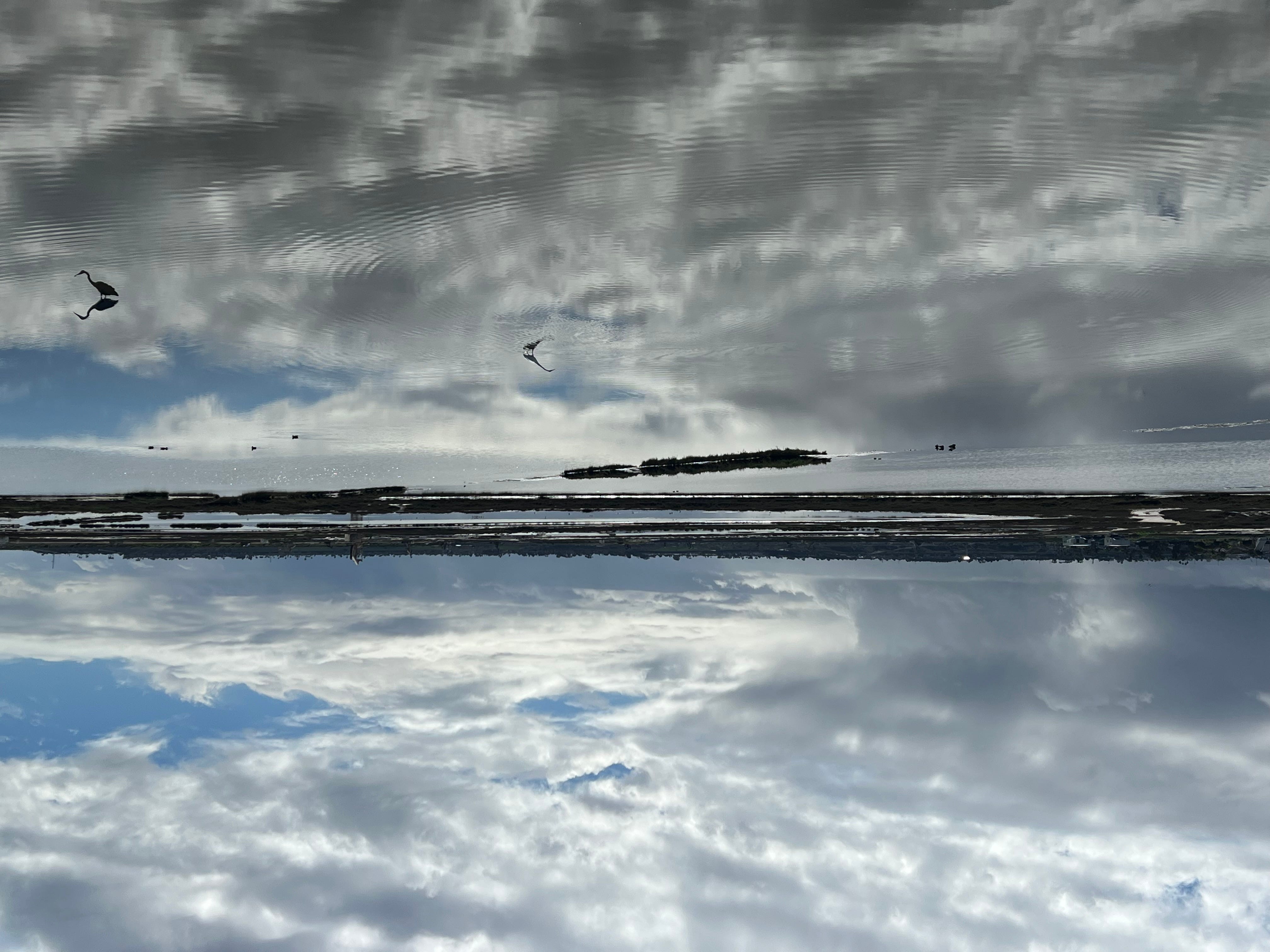
When my daughter was young, I gave a lot of thought to how I was parenting. There was the immediate, active parenting: real-time words and guidance. And then there was the quieter layer: the modeling of behavior. This passive passing isn’t direct or explicit, but it will serve as a foundation of example to her later in life. Not my words of the moment, but the etchings of my actions. As opposed to this being a byproduct, it becomes an intention. Not a thing, but a process.
How to navigate being an adult. How to hold onto dreams, passion, purpose. What priorities do we demonstrate through our choices? How can we program coherence, encoded, as a model for the adult selves of today’s children - When they become holders of the reins and the passers of the patterns?
How do we prioritize our own health and well-being… and that of our loved ones, our community, our place?
These become touchstones the generations of our youth will inherit, either consciously or unconsciously.
How we learn to hold or to heal personal trauma and the embedded systems that perpetuate, contains lessons for how we heal cultural and environmental trauma and recognize the same systems at play.
The patterns we normalize at home scale outward into the systems we design. How we put positive systems in place in one milieu, hold insight for how we might likewise use similar frameworks in others.
Consider the electric car.
Conceptually, it is an elegant solution; reduced emissions, a major shift away from fossil fuels. All excellent and necessary. But when deployed within the existing framework of growth, extraction, consumption and car-centered design that embody the Paradigm of Separation, the underlying operating system remains intact.
The extraction of lithium and rare earth minerals; the geopolitical instability surrounding supply chains; the expansion of car culture; the manufacturing and waste streams that scale alongside production: The technology changes, but the pattern does not.
What appears as a technological transition is often a continuity of worldview. And when continuity of worldview persists, scale along with technological sophistication amplifies consequence.
At planetary scale, that amplification becomes visible in the disruption of earth systems.
We are at a moment in earth history and human history - where our collective behavior is understood to be the driver, shifting the fulcrum of these changes. We once doubted our ability to impact the environment. It has now grown to become a primary influence. Which makes this, our lifetime now in the short span of human history, of significant consequence and importance.
In 2020, it was reported in the journal Nature that human-made mass had exceeded the total natural biomass of the planet. The material footprint of our endeavors now outweighs the living systems from which they (and we) have emerged. Doubling roughly every two decades.
The Amazon rainforest has withstood climatic shifts for millions of years. Yet within the span of a few human generations, its capacity to self-regulate is being destabilized.
In my home state of California, only 4% of the great redwood forests remain.
These are not isolated crises. They are cumulative expressions of an organizing logic that prioritizes expansion, extraction, and control over balance, regeneration, and interdependence.
When systems lose balance, they do not always collapse in spectacle. Often, they fray a quietly, a little bit at a time - and then all at once.
The more I sit with this tension, as a father and as someone who studies systems, a familiar refrain quietly emerges:
We are misdiagnosing the problem. The issues we name are real, but they are expressions of something more fundamental. We’re seeing the fragments but not the fractals. We’re missing the deeper signals in this fraying fabric of connection.
I saw that fraying in a room full of people I love. All those threads once anchored now blowing loose in the air. Each of us grasping, trying to hold what remained. The rupture was personal. But the pattern was not unfamiliar.
There I stood, in front of this congregation of people; his wife, his children, parents and sister, his professional community, our historic community of shared friends who came of age together, and all the life that’s filled in since then - All looking to me for some kind of comfort…
I began by summoning a breath shared with intention and connection.
Then, tried my best to gather those threads of intersection to weave a blanket reconnecting us through this trauma. Hoping to provide a small measure of comfort in the healing journey that lay ahead. Leaning into the worldview that sings of interdependence..
When rhythm slips, in a family, in a forest, in a culture, the consequences ripple outward. Not because harm was intended, but because connection was strained beyond its capacity to hold.
But, if imbalance can travel across scales, so can restoration.
In that room, something else was present. Not only grief. There was coherence. Shared breath. Shared memory. A willingness, a newly inspired desire to gather the threads again.
The duality and paradox: the world-changing work of de-patterning and reprogramming. Of healing our trauma, both that which we bear and that which we bear responsibility for.
And here, something else powerful emerges: If trauma propagates across scales, healing can propagate across scales.
From the microorganisms of the earth to our own microbiome;
From the food we grow to the way we grow our food;
From the intentions of our endeavors to the byproducts that result;
From the health we carry from youth to adulthood,
and the patterns we reinforce as adults to our kids.
The health of Nature and the nature of Health become our most coherent organizing principle.
Healing works in both ways.
Balance and belonging become structural, not sentimental.
The work before us is not to abandon progress, but to re-anchor it. To reweave the fabric of connection and recouple our systems to health and interdependence.
Living systems respond, they adapt, they self-organize. They endure.
What then, is the nature of the intelligence that exists within this web of life?
This essay is part of a developing series exploring nested systems, inherited paradigms, and the intelligence of connection.
Previous: Nested
Next: The Intelligence of Connection